July 25, 2026
One of the first questions readers ask me after finishing Bound by Secrets is:
“Is that rare book real?”
The short answer is…
Parts of it are.
One of my favorite things about writing cozy mysteries is weaving real history into fictional stories. I love taking something readers may have heard about, adding a little imagination, and building a mystery around it.
For Bound by Secrets, that meant diving into the fascinating world of rare books.
I knew from the beginning that I didn’t want the mystery to revolve around hidden jewels, buried money, or a long-lost fortune.
I wanted the treasure itself to be a book.
Not because books are valuable simply as objects, but because they carry history in a way almost nothing else can.
More Than Paper and Ink
Most people look at an old book and see…
An old book.
Collectors see something entirely different.
They notice the publisher.
The year it was printed.
The binding.
The condition of the dust jacket.
The edition statement.
The printing history.
The signatures.
Even the smallest printing error can completely change a book’s value.
That fascinated me.
Books aren’t just stories.
They’re historical artifacts.
Every crease, handwritten inscription, library stamp, or coffee stain tells part of that book’s journey.
Who owned it?
Who loved it?
Where has it traveled?
How did it survive for decades or even centuries?
Those questions are often just as interesting as the story printed inside.
The Rare Huckleberry Finn
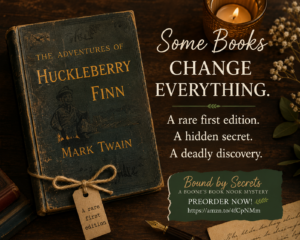
The rare edition featured in Bound by Secrets was inspired by real collectible editions that have become highly sought after because of tiny printing differences. In the novel, the mystery centers on a valuable edition identified by a specific printing error that dramatically increases its worth. That idea grew out of real publishing history, where seemingly minor variations can make one copy far more desirable than another. The series materials identify the featured edition by a page 57 typo that collectors recognize as exceptionally valuable.
When I first learned about collectible printings, I was amazed.
Imagine walking into a thrift store.
Buying a dusty old novel for a few dollars.
Only to discover later that it’s worth tens of thousands.
That sounds like something made up for fiction.
It isn’t.
Stories like that happen.
Not every day, of course.
But often enough that collectors never stop looking.
And that’s exactly what made it perfect for a mystery.
Learning the Language of Collectors
One thing I quickly discovered while researching was that rare book collecting has its own vocabulary.
First edition.
First printing.
Provenance.
Foxing.
Deckled edges.
Association copy.
Facsimile.
Dust jacket.
Binding.
Ex libris.
At first, it felt overwhelming.
But the more I learned, the more I realized collectors aren’t simply buying books.
They’re preserving history.
Every book has a biography beyond the story written on its pages.
Some traveled through generations of one family.
Others sat forgotten in attics.
Some belonged to famous people.
Others quietly waited on thrift store shelves until someone recognized what they really were.
That hidden history fascinated me.
Why Book Condition Matters
Another thing I learned is that condition changes everything.
Two identical books printed the same year can have wildly different values.
One may have torn pages, water damage, missing covers, or heavy writing inside.
Another might look as though it just left the printing press.
Collectors notice every detail.
Even something as simple as an original dust jacket can make an enormous difference.
As a reader, I understand loving a well-worn book that’s been read a dozen times.
As a researcher, I discovered collectors sometimes treasure books for entirely different reasons.
Both perspectives are valid.
They’re simply appreciating books in different ways.
The Treasure Hunt
Researching rare books reminded me that collecting is really about hope.
Hope that today’s yard sale holds tomorrow’s incredible discovery.
Hope that the forgotten box in the corner contains something remarkable.
Hope that one overlooked book has a story nobody else noticed.
I think that’s why so many readers love antique stores, flea markets, estate sales, and thrift shops.
You never know what you’ll find.
That’s certainly true in Normal.
Buck Davis’s Tough Nickel isn’t just a thrift store.
It’s a treasure hunt.
Every shelf offers possibilities.
Every dusty box deserves another look.
Readers quickly learn that in Normal, valuable things often hide in ordinary places.
Research Rabbit Holes
I’ll confess something.
Research is dangerous.
Not because it’s difficult.
Because it’s fun.
I’ll sit down intending to spend twenty minutes reading about first editions.
Three hours later, I’m learning about Victorian bookbinding techniques, antique bookplates, or the history of handwritten ownership inscriptions.
One fascinating fact leads to another.
Before long, I’ve wandered into an entirely different century.
I suspect many of you understand exactly what I mean.
Book lovers are naturally curious people.
The Stories Behind the Stories
One thing that surprised me most was realizing every rare book carries two stories.
The first is the one printed inside.
The second is everything that happened after publication.
Who bought it first?
Who gave it as a gift?
Who carefully protected it?
Who nearly threw it away?
Who rediscovered it decades later?
Sometimes those untold stories become just as fascinating as the novel itself.
That realization heavily influenced Bound by Secrets.
The mystery isn’t simply about a valuable book.
It’s about the lives connected to it.
Fiction Meets Reality
Whenever I write mysteries involving specialized topics, I try to strike a balance.
I want readers to learn something.
I never want them to feel like they’re reading a textbook.
The rare book research became seasoning rather than the entire meal.
Enough to make the mystery believable.
Not so much that it slowed the story.
If reading Bound by Secrets inspires someone to visit an independent bookstore, browse an antique shop, or look a little more closely at the books already sitting on their own shelves, then I consider that a wonderful bonus.
My Favorite Discovery
People often ask what my favorite part of the research was.
Honestly?
It wasn’t discovering how much certain books are worth.
It was realizing how many incredible stories still exist quietly on library shelves, inside family collections, and tucked away in small-town bookstores.
Books connect generations.
They survive wars.
Moves.
Families.
Time.
They’re patient.
Sometimes they wait decades before the right reader discovers them.
There’s something wonderfully hopeful about that.
Looking at Books Differently
Since writing Bound by Secrets, I don’t browse bookstores the same way.
I notice old bindings.
Handwritten inscriptions.
Interesting editions.
Local history shelves.
Forgotten classics.
Books that someone clearly loved before they found their way onto another shelf.
Every old book makes me wonder.
Who held this before me?
Where has it been?
What conversations has it witnessed?
What secrets might it carry?
Those questions are exactly what led me to write this mystery.
Because sometimes the greatest treasure isn’t hidden inside a vault.
Sometimes it’s quietly waiting on a bookshelf.
All it needs is someone curious enough to open the cover.
Reader Discussion
I’d love to hear from you!
Have you ever discovered an unexpected treasure in a used bookstore, thrift shop, or estate sale?
Do you own any books that are especially meaningful to you?
If you could own one famous rare book, what would it be?
Do you enjoy visiting independent bookstores or antique bookshops.
July 19, 2026
Behind the Book: Building Sadie Whitfield
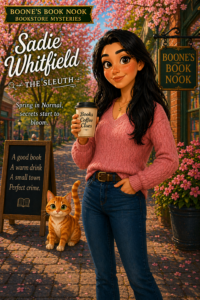
When readers first meet Sadie Whitfield, she’s standing at one of the biggest crossroads of her life.
She doesn’t know it yet.
She believes she’s taking a quick trip to Normal, Kentucky to track down a rare book before heading back to New York. It’s supposed to be a simple detour. A temporary stop. A chance to solve one problem before returning to the life she’s always known.
Instead, she’s about to discover that sometimes the story you’re meant to live is completely different from the one you’ve planned.
That’s really where Sadie began for me.
Not with her job.
Not with her car.
Not even with Boone’s Book Nook.
She began with one simple question:
What happens when someone who has built her entire identity around one life suddenly has the opportunity to build a completely different one?
A Woman Who Loves Books More Than Publishing
One thing I knew from the very beginning was that Sadie needed to be more than “the bookstore owner.”
She needed a history.
She needed experience.
She needed a reason to know books better than almost anyone else.
That’s why I made her a professional editor.
For years, Sadie worked in New York publishing, surrounded by manuscripts, deadlines, acquisitions, editorial meetings, and everything that comes with helping bring books into the world.
She wasn’t simply someone who loved reading.
She understood books from the inside out.
She knew what made a story work.
She recognized first editions.
She understood publishing history.
She could spot details most readers might overlook.
That background gave her something incredibly valuable as an amateur sleuth.
She notices details.
Editors do that.
They notice inconsistencies.
They recognize when something doesn’t quite fit.
They pay attention to tiny clues that other people skip right past.
Those instincts translate surprisingly well into solving murders.
The Outsider Looking In
Another important decision was making Sadie completely new to Normal.
Readers who’ve followed my Camper & Criminals series already know the town.
Sadie doesn’t.
That fresh perspective became one of my favorite parts of writing her.
Everything surprises her.
The slower pace.
The friendly conversations.
The businesses where everyone seems to know everyone else’s life story.
The roads twisting through the Daniel Boone National Forest.
The way strangers become neighbors almost overnight.
Because Sadie is discovering Normal for the first time, readers experience that sense of wonder right alongside her.
She’s asking the same questions they would ask.
She’s noticing the same little details.
She’s learning that in a small town, every smile has history behind it.
She’s Smart, But Not Perfect
One thing I’ve always tried to avoid is creating characters who have all the answers.
That’s not interesting.
Real people make mistakes.
They jump to conclusions.
They misread situations.
They trust the wrong people.
Sometimes they ignore the obvious clue because they’re focused on something else entirely.
Sadie does all of those things.
Yes, she’s intelligent.
Very intelligent.
But intelligence doesn’t prevent someone from making emotional decisions.
Sometimes it actually complicates them.
She overthinks.
She questions herself.
She second-guesses decisions.
She occasionally lets curiosity lead her somewhere she probably shouldn’t go.
That’s part of what makes her fun to write.
Why She Drives a Classic Volkswagen
Readers often ask about Sadie’s bright yellow 1967 Volkswagen Beetle.
It wasn’t a random choice.
Cars tell us something about their owners.
Luxury vehicles suggest one personality.
Sports cars suggest another.
The Beetle felt different.
It’s practical without being boring.
It’s memorable.
It’s charming.
Like Sadie herself, it’s a little unconventional.
It also stands out immediately in a small Kentucky town.
People notice when that little yellow Bug rolls down Main Street.
Just as importantly, readers notice it too.
I love giving characters visual details that immediately become part of their identity.
For Mae, it might be the campground.
For Dottie, it’s the curlers.
For Watson, it’s finding the best place to nap.
For Sadie, that cheerful yellow Beetle becomes part of who she is.
Learning to Slow Down
One of the biggest themes running through Bound by Secrets isn’t the murder.
It’s the difference between surviving and actually living.
When Sadie arrives from New York, she’s used to measuring success by productivity.
Deadlines.
Meetings.
Career advancement.
Publishing schedules.
Everything has urgency.
Normal challenges all of that.
People stop to talk.
They notice sunsets.
They gather on porches.
They make homemade desserts simply because someone might stop by.
Nobody seems to be racing anywhere.
At first, that frustrates Sadie.
Eventually, it changes her.
Watching her slowly embrace a different pace of life became one of my favorite character arcs.
She doesn’t become a different person.
She simply rediscovers parts of herself she’d forgotten.
Becoming a Bookstore Owner
One misconception I’ve heard from readers is that Sadie always dreamed of owning a bookstore.
The truth is a little more complicated.
She always loved books.
There’s a difference.
Working in publishing and owning an independent bookstore are two completely different experiences.
Publishing focuses on bringing books into the world.
Bookstores focus on putting those books into readers’ hands.
As Sadie settles into Boone’s Book Nook, she discovers a different kind of fulfillment.
Instead of editing stories behind the scenes, she’s recommending books to customers.
Instead of working with authors, she’s working with readers.
Instead of chasing publishing schedules, she’s creating a community.
That’s a much more personal experience.
Building Relationships
One thing I wanted readers to see was how slowly trust develops.
Nobody instantly becomes part of a small town.
Friendships take time.
People observe.
They remember.
They watch how you treat others.
Sadie earns that trust little by little.
Not because she’s trying to impress anyone.
Because she’s genuinely interested in the people around her.
She listens.
She helps.
She asks questions.
Sometimes those questions lead directly into trouble.
That’s the downside of being curious in a mystery series.
Her Greatest Strength
If I had to describe Sadie’s greatest strength, it wouldn’t be intelligence.
It wouldn’t even be courage.
It’s empathy.
She wants to understand people.
Editors spend years asking why characters make certain choices.
Sadie approaches real people the same way.
Rather than immediately deciding who’s guilty, she tries to understand motivations.
Fear.
Loss.
Greed.
Love.
Jealousy.
Those emotions matter just as much as physical evidence.
That makes her an excellent sleuth.
Her Greatest Weakness
Curiosity.
Without question.
If someone tells Sadie to stay away from something…
She’s immediately interested.
If a conversation suddenly stops when she walks into a room…
She notices.
If someone behaves strangely…
She remembers.
Curiosity has gotten plenty of fictional detectives into trouble.
Sadie proudly joins that tradition.
Fortunately, she’s rarely alone for long.
Then Watson Arrived
Every great amateur sleuth deserves a loyal companion.
Watson became exactly that.
He doesn’t solve murders.
He doesn’t point at suspects.
He simply reminds Sadie to breathe.
To laugh.
To enjoy quiet moments between dangerous ones.
Their relationship grounds the series.
Readers see a softer side of Sadie when she’s talking to Watson, carrying him around the bookstore, or laughing at one of his latest antics.
Those scenes often become my favorites.
Looking Ahead
One thing I love about writing a series is knowing my characters don’t have to become everything they will ever be in the first book.
Sadie is still growing.
She’s still discovering who she wants to become.
Every mystery teaches her something new.
Every friendship changes her.
Every customer leaves a small impression.
Readers will watch her confidence grow as Boone’s Book Nook becomes more than a bookstore.
It becomes her home.
And I have a feeling she’s only just getting started.
Writing Sadie has reminded me that reinvention doesn’t have an expiration date.
Sometimes all it takes is one unexpected trip.
One small town.
One bookstore.
And one decision to stay just a little longer than you planned.
Reader Discussion
I’d love to hear your thoughts!
What was your first impression of Sadie?
Which of her qualities do you relate to most?
Have you ever made a life-changing decision you didn’t see coming?
If you moved to Normal, which job would you want: bookstore owner, editor, librarian, or something else?